Ross Stores: A Cheap Seller of Cheap Goods
A great deal of value investing is the process of elimination. Warren Buffett, when asked how he finds undervalued stocks, simply replied “Start with the A’s.†But in most markets only a small fraction of securities count as underpriced on an absolute basis, so value investing requires wading through an endless sea of crap in search of the delicious low-hanging fruit (yes, in this example fruit comes from the sea). Given my affinity for this mode of investing, how could I not like Ross Stores (ROST)?
 Ross Stores is a discount retailer that sells clothing and home accessories, and gathers much of its apparel through sniping manufacturer overruns and cancelled orders, much as investors would do if they want something on sale. This strategy can acquire some highly desirable and serviceable clothing, but much of Ross’s purchases are not in demand for a good reason (lime green pants, anyone?). How could a value investor not like this business model? For people who like the thrill of the hunt aspect of shopping it creates a fine shopping experience.
As you may imagine, Ross has been doing very well at luring customers during a recession. They are on pace to earn $400 million this year, when normally they earn somewhere in the $300 million range. This ability to do well in a recession reminds me of Rayonier or Compass Minerals. I discussed Rayonier as an inflation hedge, with the advantage over gold and TIPS that they can produce a decent return even without inflation. Upon reflection, I believe that Compass Minerals offers the same advantage from its salt and fertilizer. Road salt is a widely used de-icer and is vital in regions that are not so environmentally concerned as to adopt calcium or magnesium chloride, and fertilizer is similarly impossible to do without, so I am convinced that Compass Minerals is also good for an inflationary situation.
Ross is not a hedge against inflation, but the fact that its sales increase when the economy weakens and sales everywhere else tend to decrease, makes it a useful hedge against an economic downturn. Even after this growth, Ross trades at a P/E ratio of 13.6, which has actually been trending down of late. Thus, it does not really produce outsize returns, but its robustness in a recession is attractive. I normally prefer an earnings multiplier of about 10, because I try to avoid overpaying for growth, which often translates to “I try to avoid paying for growth,†and if I can usually find 10 anyway, why depart from it? In fact, if we go by Ross’s more typical historical earnings, at current prices Ross would have a P/E ratio of 18. However, I do feel that Ross is entitled to some premium from its ability to hedge against a downturn, and since they have been opening new stores all the while, at least some of the expansion of sales is here to stay, and not just the temporary influence of thrift.
I should mention, though, that Ross uses share buybacks instead of raising its dividend, and I Â wish they would declare a dividend and be done with it, since it suggests a greater degree of stability and permits all shareholders to benefit immediately from positive cash flows. Certainly a share buyback concentrates the effect of future earnings, but existing earnings have to count for something too.
So, I am convinced that Ross is one of those great companies at a good price that Warren Buffett talks about, but, like Graham, I have always been suspicious of the view that if you get a good quality stock the price will take care of itself (I’ve always thought the reverse was more accurate), and at any rate, the time to hedge against a recession is over; one’s already here. Nonetheless, this king of discount stores comes with a built-in put option on the rest of the economy and should be entitled to a premium for it. And despite what the regulators would have you believe, this is not the last recession we’re ever going to have.
 Rentech has a patented and proprietary method for turning synthetic gas (a mixture of carbon monoxide and hydrogen) into hydrocarbons usable for fuel, and synthetic gas apparently can be manufactured from ordinary waste. From the company’s overview in their SEC filings, they seem to make much ado of the fact that synthetic gas comes from urban and rural garbage, sugar cane refuse and other biomass, which gives them green credentials and also qualifies them for a
  Curiously, though, the company also owns a profitable segment: they use natural gas to produce nitrogen fertilizer. This Cinderella of a subsidiary supplies the operating needs of the company and also occasionally allows them to turn a profit (like last quarter, although it was the seasonal peak for demand of ammonia fertilizer). In fact, in 2008 if you neglect R & D expenditures, they turned a profit. According to Damodaran, research and development should be treated as a capital expenditure, rather than a flat expense, because it is not all money thrown away. In 2009 to date, Rentech have ratcheted down their R & D, but it seems to me that by acquiring these two new synthetic gas producers they have simply bought their research instead of doing it in-house.
 At any rate, consider Quiksilver, which makes clothes. Like so many companies, they have profitable operations but no actual profits because they are a friend of debt. But debt is not returning the favor. Of course, the acceptable debt level for a firm varies; the debt level that a utility would find quite bearable would strangle a manufacturer, for example, but when operating income is consumed entirely by interest payments and the shareholders get hardly anything, there is too much debt to make the equity look attractive. Of course, the academic financiers have argued that in an environment with income taxes and no defaults the optimum capital structure is 100% debt, and this discovery was apparently viewed as some sort of grand discovery on par with splitting the atom, although in terms of usefulness they may as well have told us what the optimum capital structure would be if the CEO were a unicorn (although this principle might explain why AIG is trading at a price above zero).
 But in the case of Quiksilver, the senior notes are also unsecured, and they also have a secured line of credit of up to 320 million in Europe, a 150 million privately placed note, also secured, and 20 million secured on a US line of credit, on which they have another 180 million available (which does give confidence in Quiksilver’s ability to ride out a further weak patch in the economy, but if they fail to do so it’s just that much more debt in line ahead of the bonds). So, about 500 million in secured debt are in line ahead of the notes, and on top of another 220 million in trade credit and some other debts, there are, say, 750 million in higher priority debts over the bonds, which eats up nearly all of their cash, receivables, and inventories. What remains is 75 million in current assets, 237 million in plant and equipment, and so the remaining 87 million in bonds is left to look to intangibles, goodwill, and “other.â€
 So, how did it come to pass that Bon-Ton’s bonds are backed by more assets than those of Callon Petroleum and Quiksilver? I think part of it might be the nature of the bonds. Bon-Ton’s bonds were issued in order for them to complete a large, expansionary acquisition, and the market realized the speculative nature of that expansion by giving them an interest rate of 10.125%. In other words, the bonds were junk and then became junkier. Callon’s bonds were perfectly well secured until falling oil prices and a couple of hurricanes caused them to take a huge writeoff, and even so their coupon was 9.75% representing the riskiness of the oil development in the Gulf of Mexico. Quiksilver’s bonds, though, were issued with a coupon of 6.875%, which is not indicative of junk and suggests that the company was considered a reasonably safe issuer that has suffered some deterioration over time, so their creditors were clearly not thinking about bankruptcy at all when they purchased the bonds.
 However, it seems to me that this acquisition is unlike the other three purchases. In those cases, the price paid, if you indulged management’s optimism about synergies, and taking into account the excess of depreciation over capital expenditures, you still wound up with a price/free cash flow of around 10. Here, Windstream claims that about 8% of the purchase price consists of tax loss harvesting (which the Tax Code has very Byzantine rules about, but for 8% it is not the driver of the transaction so I wouldn’t be too worried).  But of the other 92%, I find that net income plus depreciation minus capital expenditures comes to an average about 50 million a year, which, given the $530 million paid for the equity is close to 10 but not quite there.
 However, the majority of junk bonds are junk for a reason, and they require careful screening. Consider the bonds of Callon Petroleum Co., which pay 9.75% and are trading at 60, currently yielding 16%. They fall due in December of 2010, but most of those bonds will never be redeemed, because the firm was forced to institute a tender offer because what with two hurricanes and a drop in the price of oil they were forced to discontinue a large operation in the Gulf of Mexico. Their other operations are barely able to cover their interest. The terms of the
  Indexing, long touted as the safe long-term option for the passive investor, has shown itself to be riskier than we all imagined, producing a negative 10-year return. If stocks always beat bonds over the long term, claim the authors of Dow 36000, then they are in fact less risky than stocks and thus the Dow deserves to be at 36000. If, however, they are more risky, then the index fund industry has some explaining to do.
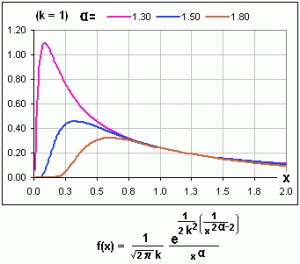 It is disturbing, though, that the regulators still embrace value at risk, which assesses the risk of loss on a financial asset by applying a stochastic process based on volatility that has been observed over a certain period, typically less than five years. Of course, the five years before 2008 were extremely boring in terms of volatility. Value at risk could perhaps be preserved if the period surrounding the collapse of Lehman Brothers was used as representative, but it would be quicker to abandon the stochastic myth, since security prices stop behaving as though they follow a stochastic process just about when panic strikes and every market participant wants them to be stochastic. In a book I read called Lecturing Birds on Flying, Pablo Triana suggests a Levy distribution, whereby events that are 6 standard deviations away from the norm may be predicted to occur every couple of decades instead of every couple of eons. I’ve never been that swayed by quantitative analysis, but if regulators are going to use a quantitative method they could at least use one that hasn’t been demonstrated not to work.
 But as for Coinstar, it is true that they have increased their sales by $90 million since the same quarter last year, but do you happen to know by how much they increased their profits? Less than $2 million. So it is clear that we are dealing with a low profit margin firm, and now one that is facing increased competition from Blockbuster kiosks, as well as having to deal with Netflix and several antitrust suits that I don’t think they’re going to win. As I mentioned before, when Coinstar bought out its co-owners the price paid implied a value of $300 million for the entire Redbox division, and the counterparty was a sophisticated seller that had access to inside information, that probably concluded that the business was not likely to generate excess returns from any more capital put in, and based on these margins I am inclined to agree. Their other divisions have been more or less flat, so I remain unconvinced that this company is going to produce the kind of growth that will justify their still-optimistic valuation.
 In addition to being a good strategic fit, management claims that the acquisition will be accretive to cash flow. Accretiveness to cash flow is the easiest thing in the world: just buy a company with a lower P/E ratio than yours. And, if you put all the depreciation back in and indulge management’s view of $30 million in synergy, (canceling one optimistic assumption with one pessimistic one about depreciation), you get a P/E of 11, which is a little bit below WIndstream’s unadjusted trailing P/E ratio, but of course Windstream’s cash flow is significantly higher. So, the actual accretiveness is up in the air.
 Even going by market prices, at $3 a share, the company loses 60 cents times 5 million shares, $1.16 times 1.75 million in the 5-year warrants, and 76 cents times 500 thousand in the 2-1/2-year warrants, total $5.41 million. Before the deal was announced, the firm was trading at $3 a share with 25 million shares outstanding, total $75 million. After the announcement yesterday, the share price dutifully retreated to $2.70, total market cap $67.5 million. It fell further today, of course, but what didn’t?
 (It is curious, though, that the closing price $2.69, settled right between the above-calculated diluted values; I would never imply that the markets are efficient, but at the very least they are paying attention).